
Popular Decluttering Methods: What Works, What Doesn’t & Where They Fit
In this post:
Which decluttering methods actually work?
Popular decluttering methods can make certain parts of getting your home under control easier, but most aren’t complete solutions. Some help you start, some make decisions easier, and others help you see your space differently. Here’s what I think is useful about today’s popular decluttering methods, where they fall short, and how they fit into the bigger process I teach with the Home RESET Method.
Swedish Death Cleaning.
The 20/20 Rule.
The Boundary Method.
The Ski-Slope Method.
House Hushing.
Spend enough time looking for help with clutter and you’ll discover there is no shortage of decluttering methods, rules and techniques promising to make the job easier.
And honestly?
A lot of them have something useful to offer.
I’ve been helping women declutter, organize and create homes that are easier to live in for years, and I don’t think we need to dismiss a useful idea simply because it has a trendy name.
But I also don’t think you need to abandon whatever you’re doing and start over every time another decluttering method starts making the rounds online.
Because here’s what I’ve noticed:
Most popular decluttering methods solve one particular problem.
One helps you get started when a room feels overwhelming.
Another gives you a question to ask when you can’t decide whether to keep something.
Another helps you establish limits around how much you own.
Another lets you experience what your home feels like with less visual noise.
Those can all be useful.
But they’re not necessarily complete systems for getting your home under control.
So when I look at a decluttering trend or technique, I don’t ask:
Is this THE method everyone should be using now?
I ask:
What problem does this solve?
What does it do well?
Where does it fall short?
And:
Where does it fit in the bigger process of creating a home that’s easier to manage?
Those are much more useful questions.
First: Is Decluttering Actually the Problem?
Before you try another decluttering method, there’s an even more important question:
Do you actually have a clutter problem?
Because a messy home can have several different causes.
You might have too much stuff.
You might have a perfectly reasonable amount of stuff, but it doesn’t have logical places to live. That’s an organization problem.
Or you may have good systems that simply aren’t being maintained consistently. That’s more of a habits and routines problem.
And from the middle of a messy room?
Those can all look exactly the same.
That’s one reason you can declutter and declutter and declutter and still wonder:
If you’re not sure which problem you’re actually dealing with, start with How to Know Whether You Have a Clutter, Organization or Habit Problem or take my free Messy Home Diagnostic.
Because the right solution starts with identifying the right problem.
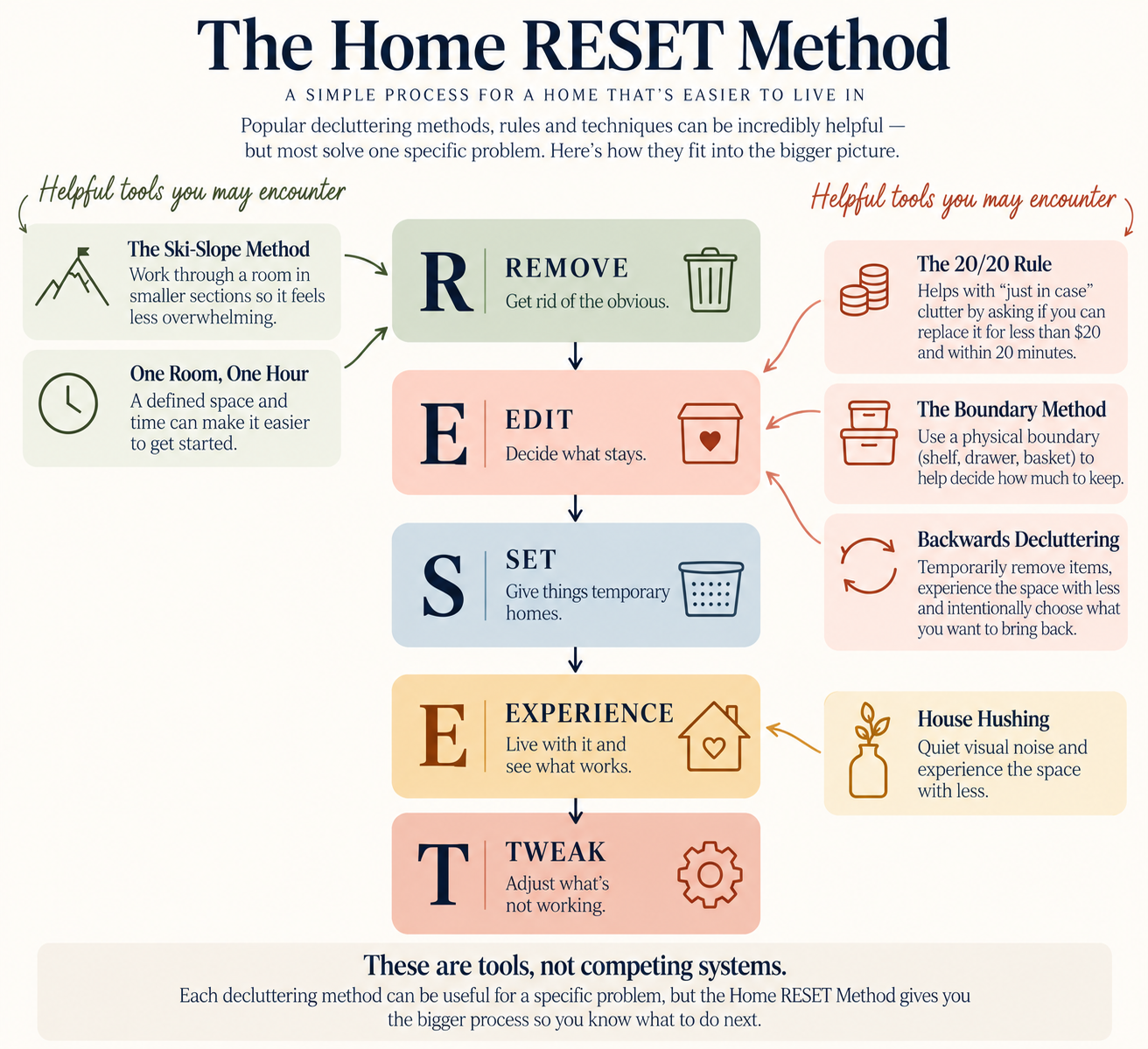
The Bigger Process: The Home RESET Method
Once you know what you’re dealing with, it helps to have a bigger process.
I created the Home RESET Method because getting your home under control requires more than getting rid of things.
RESET gives you an order to work in:
R — Remove the Obvious
Start with the easy stuff.
Trash.
Recycling.
Things that clearly belong somewhere else.
Anything that can leave the space without requiring a difficult decision.
E — Edit
Now you declutter.
But rather than tearing apart an entire room, you work micro-zone by micro-zone.
One drawer.
One shelf.
One surface.
One small section at a time.
S — Set Temporary Homes
Once you’ve decided what you’re keeping, those things need logical places to live.
And I deliberately call them temporary homes.
You’re making your best decision based on where and how you actually use something, not expecting yourself to create the perfect organizing system on your first attempt.
E — Experience the Space
Then you live with it.
Do people actually put things away?
Does the location make sense?
Does the room feel easier to use?
Where does clutter naturally start collecting again?
You’re gathering information.
T — Tweak What’s Not Working
Finally, use what you’ve learned.
Change the location.
Change the container.
Change the routine.
Change whatever isn’t working.
That’s the process.
And once you see the whole process, something interesting happens:
Most popular decluttering methods fit into one small part of it.
That doesn’t make them useless.
It just means you need to know what job you’re asking them to do.
When the Problem Is Getting Started
Sometimes you know you need to deal with your stuff.
You just can’t figure out where to begin.
The room feels too big.
Your eyes bounce from one mess to another.
And before you’ve even started, your brain has essentially said:
Nope.
This is where techniques that reduce the size of the problem can help.
The Ski-Slope Method
The Ski-Slope Method, created by interior designer and therapist Anita Yokota, gives you a way to move through an overwhelming room by working through smaller sections rather than tackling everything at once.
What I like: It gives your attention somewhere specific to go.
Instead of seeing the whole room as one enormous project, you’re dealing with the small section in front of you.
What I’d change: I’d give you permission to make it even smaller.
You don’t necessarily need to keep skiing until the entire room is finished.
One corner might be today’s project.
One section of floor.
One surface.
Progress still counts when the whole room isn’t finished.
Where it fits: REMOVE, with some overlap into EDIT.
My verdict: A useful technique when visual overwhelm is keeping you from starting.
Read next: The Ski-Slope Method: Does It Actually Make Decluttering Easier?
One Room, One Hour
The One Room, One Hour approach creates two boundaries around the project:
One room.
One hour.
That’s already considerably less intimidating than “declutter my house.”
What I like: A defined space and stopping point can make it much easier to begin.
What I’d change: An entire room and a whole hour may still be too much.
If 20 minutes is what you have, use 20.
If one drawer is what you can handle, do one drawer.
The goal isn’t to meet an arbitrary minimum before your effort counts.
Where it fits: REMOVE and EDIT.
My verdict: Useful if a defined time and space help you focus. Shrink either one if they don’t.
Read next: One Room, One Hour Decluttering: Does It Really Work?
The Principle Underneath Both: Make the Problem Smaller
This is bigger than either named method.
When your whole home feels overwhelming:
Make the problem small enough to solve.
Not the house.
Not necessarily the room.
What’s one small thing you can make better?
If this is where you’re stuck, read How to Get Your Home Under Control When Everything Feels Overwhelming next.
When the Problem Is Deciding What Stays
Once you’ve Removed the obvious, RESET moves into Edit.
This is where most traditional decluttering happens.
And it’s also where you’ll find a lot of popular decluttering rules.
That’s because these rules are usually trying to help you answer some version of:
Should I keep this?
Different questions work for different sticking points.
The 20/20 Decluttering Rule
The 20/20 Rule, from Joshua Fields Millburn and Ryan Nicodemus of The Minimalists, is designed to help with “just in case” clutter.
If you’re keeping something because you might need it someday, ask whether you could replace it for less than $20 and within about 20 minutes.
What I like: It takes a vague future fear and makes it concrete.
If the only reason you’re keeping an inexpensive, easily replaceable object is:
But what if I need this someday?
the question can be helpful.
What I’d change: I wouldn’t apply it to everything you own.
Something being inexpensive and replaceable doesn’t automatically make it clutter.
Where it fits: EDIT.
It’s a decision-making tool, not an entire decluttering process.
My verdict: Useful for a very specific problem: “just in case” clutter.
Read next: The 20/20 Decluttering Rule: Does It Actually Work?
Swedish Death Cleaning
Swedish Death Cleaning comes from Margareta Magnusson’s The Gentle Art of Swedish Death Cleaning and the Swedish idea of döstädning.
The underlying idea is to intentionally deal with your possessions during your lifetime rather than leaving all those decisions to someone else someday.
What I like: It invites us to think differently about ownership.
Everything we own requires something from us:
Space.
Care.
Organization.
Attention.
And eventually, a decision about what happens to it.
What I’d change: I wouldn’t wait until later in life to ask those questions.
I think they’re worth asking now:
Does this deserve the space, care and energy I’m giving it?
For me, that also connects naturally to stewardship and caring well for what we have.
Where it fits: Primarily EDIT, as a mindset that can help you make more intentional decisions.
My verdict: A thoughtful perspective on possessions. Not a complete system for creating a functional home.
Read next: Swedish Death Cleaning: What It Gets Right About Clutter.
The Boundary Method
The Boundary Method, taught by Erica Lucas, assigns a physical boundary to a category.
One shelf.
One drawer.
One basket.
One section of a closet.
That space helps determine how much you keep.
There’s significant overlap here with decluttering expert Dana K. White’s long-established Container Concept, which also recognizes the available physical space as a natural limit.
What I like: Your home has physical limits whether you acknowledge them or not.
A boundary can give you useful information about how much of a category your home can reasonably hold.
What I’d change: Don’t confuse:
It fits
with:
It functions well.
You can technically cram everything into a drawer and still hate opening that drawer every morning.
And when something doesn’t fit, don’t automatically buy a larger container.
Ask:
Do I actually want to give more of my home to this?
Where it fits: Primarily EDIT, with overlap into SET.
My verdict: A useful way to establish limits, as long as fitting isn’t the only goal.
Read next: The Boundary Method for Decluttering: Does It Actually Work?
Backwards Decluttering
Backwards Decluttering is closely connected to Myquillyn Smith’s House Hushing approach.
In Myquillyn’s original explanation of House Hushing, she describes it simply as backwards decluttering.
Instead of standing among all your belongings and deciding what to get rid of first, you temporarily remove the smaller things, experience the space with less, and then decide what you actually want to bring back.
Her House Hushing work has since grown into a broader approach, with Backwards Decluttering identified as one of its principles.
What I like: It changes the order of the decision.
Traditional decluttering often asks you to make decision after decision before you get much visual payoff.
Backwards Decluttering lets you experience the payoff first.
Then you decide.
What I’d change: As usual, I’d make the project smaller if you’re already overwhelmed.
You don’t necessarily have to start with an entire room.
Try one shelf.
One surface.
One drawer.
One small area.
Where it fits: Primarily EDIT, although the experience of the quieter space is an important part of how the technique works.
My verdict: A useful approach when decluttering decision fatigue is what keeps you stuck.
Read next: Backwards Decluttering: A Different Way to Decide What Stays.
When Decluttering Isn’t Enough: Where Should Everything Live?
And now we reach an important point.
You’ve Removed the obvious.
You’ve Edited what you’re keeping.
Great.
Where does everything go?
Your home can contain a perfectly reasonable amount of stuff and still be frustratingly messy if those things don’t have logical places to live.
This is where a lot of decluttering advice starts running out.
In RESET, you move into Set temporary homes.
And this is where I pay attention to how your household actually lives.
Where do you use the thing?
Where do you naturally look for it?
Where does it keep landing?
How easy is it to put away?
If the devotional books continually land on the dining room table, for example, the solution may not be trying harder to carry them to some “proper” bookshelf across the house.
Maybe they need a home near the dining table.
That’s the idea behind House Mapping: use the patterns already happening in your home to help you decide where your things should actually live.
If you’ve decluttered but still struggle with where everything goes, read How to Decide Where Everything Should Live in Your Home.
And if you’re still not sure whether you’re dealing with clutter or organization in the first place, read Decluttering vs. Organizing: What Should You Do First?
When Your Home Feels Visually Loud: House Hushing
Now we come back to House Hushing.
Because although Backwards Decluttering and House Hushing are closely related, there’s another part of House Hushing that I find especially useful:
experiencing your home with less visual noise.
Myquillyn’s original House Hushing technique temporarily removes the smaller items and decor from a room before you decide what returns.
You get to live with the quieter room first.
What I like: The experience.
Sometimes we don’t know how much visual noise we’ve become accustomed to until we experience a room without it.
And sometimes an empty surface teaches us something.
An empty surface isn’t unfinished. Sometimes it’s breathing room.
What I’d change: If hushing an entire room feels like too much, hush one micro-zone.
One mantel.
One dresser.
One shelf.
One counter.
Experience that.
Then decide.
Where it fits: House Hushing is Myquillyn’s approach, not part of RESET. But its emphasis on experiencing the space resonates with something I teach too.
We simply use that experience at different points.
House Hushing lets you experience less before making all the final decluttering decisions.
In RESET, you Experience your new homes and systems after Edit and Set so you can see whether they work in real life before you Tweak them.
My verdict: A valuable way to see your home differently, especially when the problem is visual noise or when you need a visual win before you’re ready to make all the decisions.
Read next: House Hushing: Can Quieting Your Home Help You See It Differently?
What Happens When the Mess Comes Back?
And now we’ve reached the part that a lot of decluttering advice never gets to.
You’ve decluttered.
You’ve organized.
You’ve found homes for things.
And then…
real people live in the house.
Shoes appear by the door.
Books land on the dining table.
Mail accumulates on the counter.
The same pile keeps coming back.
This is where I don’t want you thinking:
I guess I need to declutter again.
I want you asking:
Why does this keep happening here?
Recurring mess is information.
Maybe something has the wrong home.
Maybe the storage is inconvenient.
Maybe the container is too small.
Maybe the system has too many steps.
Maybe you need a simple routine attached to something you’re already doing.
So you Tweak.
That’s how a home gets easier to manage over time.
Not because you finally discover the magical decluttering method that permanently fixes everything.
Because you’re willing to notice what’s not working and adjust it.
If you’ve ever organized your home only to watch the same mess return, read Why Your Home Gets Messy Again After You Organize It.
What About the Sunday Reset?
The Sunday Reset is different from most of the approaches we’ve discussed because it isn’t really a decluttering method.
It’s a maintenance routine.
And if you enjoy spending a little time on Sunday preparing your home and life for the week ahead?
Great.
The problem comes when Sunday becomes the day you have to rescue your entire house from the previous week.
That’s why I prefer simple RESET Routines throughout the week.
RESET Routines are small habits and rhythms that help your home regularly recover from everyday life.
Then, when one particular area gets away from you, you can use a Micro RESET to bring that small space back toward baseline.
Those do two different jobs:
RESET Routines help prevent everyday buildup.
Micro RESETS help recover a particular area when it needs extra attention.
And if you’re repeatedly resetting the exact same mess?
That’s when you look underneath it and Tweak the system.
Read next: The Sunday Reset: Why I Don’t Think You Need One Big Weekly Reset.
So Which Decluttering Method Is Best?
Here’s the important part:
You don’t need to choose one.
Most of these aren’t competing complete systems.
They’re different tools for different problems.
| If you’re struggling with… | A tool or idea that may help | Where it fits |
|---|---|---|
| A room feels too overwhelming to start | Ski-Slope Method | Remove |
| You need a defined project | One Room, One Hour | Remove/Edit |
| “What if I need it someday?” | 20/20 Rule | Edit |
| Becoming more intentional about possessions | Swedish Death Cleaning | Edit |
| A category keeps overflowing | Boundary Method | Edit/Set |
| Decision fatigue keeps you stuck | Backwards Decluttering | Edit |
| Your home feels visually noisy | House Hushing | Experience-related |
| Things don’t have logical homes | House Mapping | Set |
| Everyday mess keeps accumulating | RESET Routines | Ongoing maintenance |
| One small area has gotten away from you | Micro RESET | Quick recovery |
| The same mess continually returns | Tweak the underlying system | RESET |
Use the right tool for the problem in front of you.
That’s very different from starting over with a new method every six months.
What About KonMari, Clutterbug, Dana K. White and Other Organizing Methods?
Of course, these aren’t the only approaches out there.
And there’s an important distinction between a useful little decluttering rule and another expert’s complete framework or body of work.
For example:
Dana K. White teaches a broader no-mess approach to decluttering, including her Container Concept.
Cass Aarssen created the Clutterbug organizing-style framework, which recognizes that different people need different kinds of organizing systems.
Marie Kondo created the KonMari Method, with its own philosophy, category order and decision-making process.
I’m not going to pretend those are all interchangeable with a five-minute decluttering rule.
They’re not.
And I’m also not going to pretend there’s nothing useful to learn from other experts simply because I teach my own method.
There are lots of smart people teaching helpful things about our homes.
You may hear an idea from one of them that completely changes the way you think about something.
Great.
Use what’s useful.
But understand what problem that idea is solving.
That’s the part that matters.
You Don’t Need Another Trend. You Need to Know What to Do Next.
I love a useful idea.
If the 20/20 Rule helps you finally let go of a box of “just in case” stuff, use it.
If Backwards Decluttering makes an impossible decision easier, use it.
If House Hushing helps you realize your eyes desperately needed some breathing room, use it.
If the Ski-Slope Method gets you moving when a room feels impossible, use it.
You don’t have to reject every other good idea in order to have a process you trust.
You just need to understand where those ideas fit.
That’s what the Home RESET Method gives you.
An order.
A process.
A next step.
Remove the obvious.
Edit what you’re keeping.
Set temporary homes.
Experience the space.
Tweak what’s not working.
And notice something important:
RESET doesn’t stop when the decluttering is done.
Because the goal isn’t to become really good at getting rid of stuff.
The goal is to create a home that supports you.
A home that’s easier to live in.
Easier to keep up with.
And easier to bring back to a calm, happy baseline when real life inevitably makes it messy again.
Not Sure Where You Need to Start?
Before you choose another decluttering method, figure out what problem you’re actually trying to solve.
Take my free Messy Home Diagnostic to find out whether clutter, organization or home habits are creating the biggest problem in your home right now.
Then you can choose the right next step instead of starting over.
Don’t start over. RESET.