In this post:
What is the Boundary Method for decluttering?
The Boundary Method for decluttering uses a defined physical space, such as a drawer, shelf, basket or cabinet, to limit how much of a category you keep. Once your belongings comfortably fill that space, you’ve reached the boundary. It can be a helpful way to control clutter, but making everything fit isn’t the same as creating an organized space that actually functions well.
If you’ve ever tried to squeeze one more sweater into an already-full drawer or balance one more mug on an overcrowded shelf, the Boundary Method for decluttering might sound pretty appealing.
The basic idea is simple:
Choose a physical boundary for a category of belongings, and only keep what comfortably fits inside it.
Your sock drawer is the boundary for your socks.
One shelf might be the boundary for your mugs.
A basket might be the boundary for extra blankets.
Once that space is comfortably full, that’s your limit.
And honestly?
I think boundaries can be incredibly helpful.
Our homes have physical limits whether we acknowledge them or not.
But I wouldn’t start with the container.
I’d start with the stuff.
What Is the Boundary Method for Decluttering?
The Boundary Method is a decluttering approach from Erica Lucas that uses a physical space, such as a drawer, shelf, basket, bin or cabinet, to establish a limit for how much of something you keep.
Instead of trying to decide on an arbitrary number:
How many mugs should I own?
You let your home help answer the question.
Maybe you’ve decided one kitchen shelf is where your everyday mugs live.
You put your favourites and the ones you actually use on that shelf.
When the shelf is comfortably full, you’ve reached your boundary.
The remaining mugs don’t automatically earn another shelf.
Instead, you decide whether they’re worth keeping.
That’s the part of this method I really like.
You may have heard a very similar idea before.
Decluttering expert Dana K. White has taught her Container Concept for many years. In Dana’s approach, the container is a natural limit: a drawer, shelf, closet or even a room can only comfortably hold so much.
There’s significant overlap between the two ideas, and I think the underlying principle is useful:
Your home has limits.
The important question isn’t how much you can possibly squeeze into those limits.
It’s how much your home can comfortably hold and still function well.
Your Home Has Limits
I don’t think we talk about this enough.
Our homes have a finite amount of space.
We can add shelves.
We can buy bins.
We can reorganize closets.
We can find clever storage solutions.
But eventually, our homes can only comfortably hold so much.
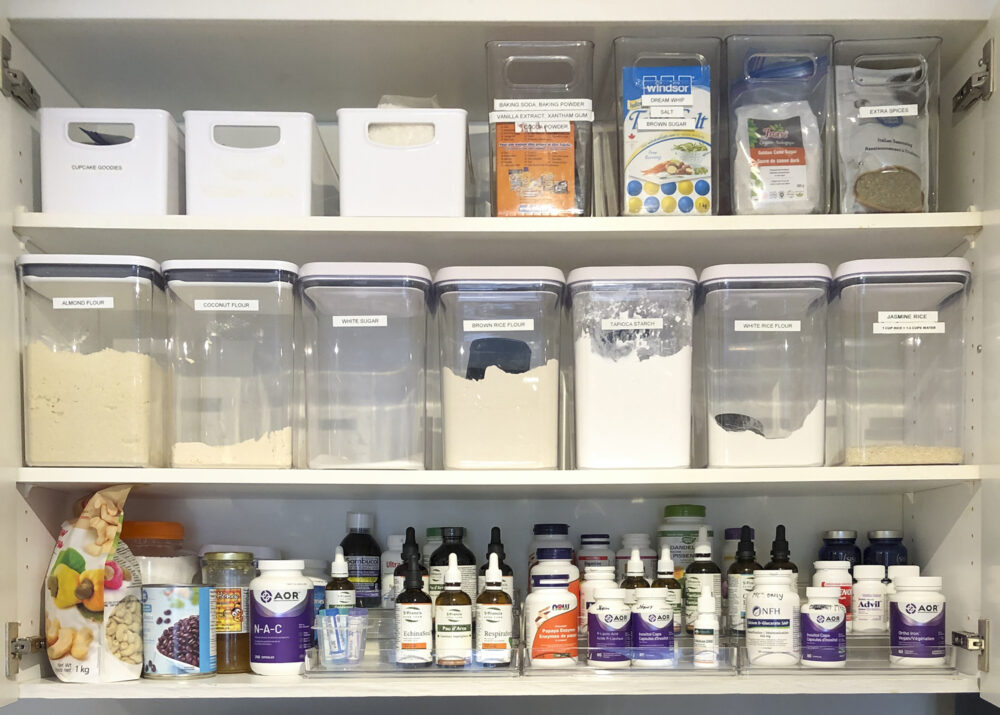
And there’s a difference between something technically fitting and a space actually functioning well.
If you have to shove the drawer closed, it’s too full.
If you have to remove four things to get to the thing you need, it’s probably too full.
If everything falls over every time you take something off the shelf, it’s too full.
If putting something away requires rearranging the entire cabinet like a game of Tetris, it’s too full.
A boundary gives you permission to say:
This is enough space for this category.
That’s useful.
Where I Think the Boundary Method Can Go Wrong
Here’s where I’d be careful.
I don’t want the container to make every decision for you.
Imagine you’ve designated a large basket for throw blankets.
You own eight blankets.
Technically, all eight fit if you roll them tightly, stand them vertically, arrange them just right and push down on the top three.
Success?
Not really.
The goal isn’t to prove that your belongings can physically fit inside a boundary.
The goal is to create a home that’s easy to use and easy to maintain.
There’s a big difference.
A drawer that’s packed to 100 percent capacity might technically contain everything.
But if it’s frustrating to use every morning, the system isn’t working.
Fitting isn’t the same as functioning.
Declutter Before You Organize
There’s another potential trap with the Boundary Method.
You can very easily turn it into an organizing project.
You buy a bin.
You add dividers.
You arrange everything beautifully.
You squeeze in as much as possible.
And now you have exactly the same amount of stuff you started with.
It’s just prettier.
That’s why I teach Edit before Set in my RESET Method.
Before figuring out exactly how you’re going to organize a category, decide what you actually want to keep.
Do you use it?
Do you need it?
Do you genuinely like having it?
Does it deserve the space and care it requires?
Then you figure out where those things should live.
Your available space can give you useful information as you Edit. But I still want you deciding what you actually use, need and want, rather than simply asking how much you can squeeze into the container.
A Boundary Doesn’t Tell You Where Something Should Live
There’s another piece the Boundary Method can’t solve on its own.
You can have exactly the right amount of something and still have it in the wrong place.
Maybe you’ve created the perfect basket for something.
Everything fits.
It looks lovely.
But nobody ever puts the things back in the basket.
Before assuming your family is the problem, I’d ask:
Is this actually where these things naturally get used?
Where do they keep landing instead?
That’s information.
If books are constantly piling up beside the chair where someone reads them, putting their basket across the room might not make sense.
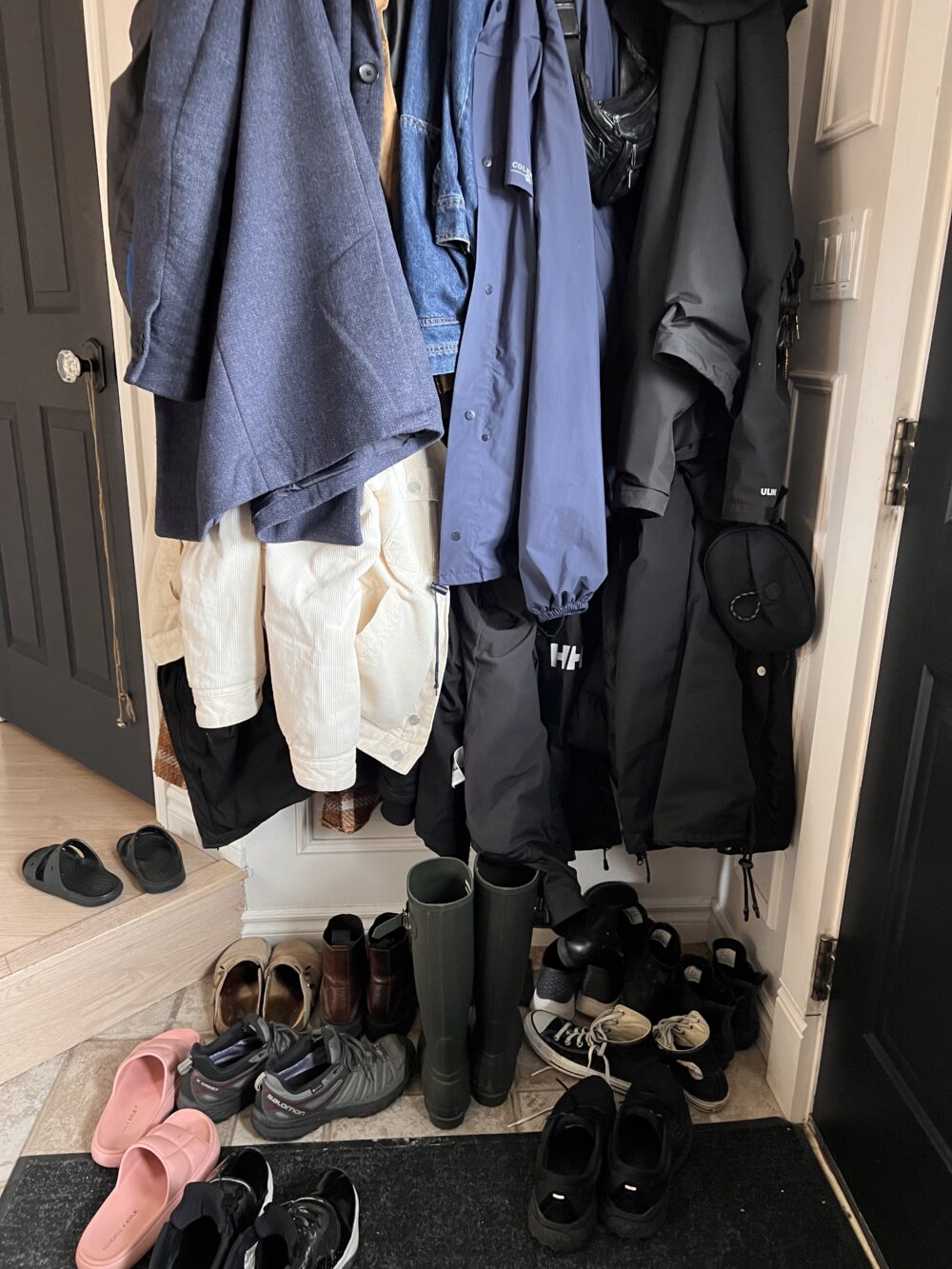
If shoes always come off at one particular door, their home probably needs to be close to that door.
If something repeatedly lands on your kitchen counter even though you’ve given it a perfectly organized home somewhere else, pay attention.
A good organizing system doesn’t just answer:
Where can this fit?
It answers:
Where does this make sense?
Where the Boundary Method Works Really Well
There are plenty of places where I think physical boundaries are extremely useful.
Think about categories that tend to multiply quietly:
- travel mugs
- reusable water bottles
- food storage containers
- towels
- sheets
- cleaning supplies
- toiletries
- craft supplies
- toys
- books
- seasonal decor
- clothes
You don’t necessarily need a rule telling you that you’re allowed exactly six travel mugs.
Maybe your family genuinely uses twelve.
Instead, decide where travel mugs logically belong.
Edit the ones you don’t use or want.
Then see how your keepers fit into the space you’ve given them.
If they fit comfortably and the space works?
Great.
If they’re overflowing?
Now the boundary is giving you useful information.
Don’t Automatically Buy a Bigger Container
This might be my favourite lesson from the Boundary Method.
When something doesn’t fit, our first instinct is often:
I need more storage.
Maybe.
But not always.
Before buying another bin, adding another shelf or giving the category more real estate in your home, ask:
Do I actually want to give more of my home to this?
That’s a very different question.
You can dedicate three kitchen cabinets to reusable food containers.
But do you want to?
You can buy another shelving unit for craft supplies.
But is that how you want to use that space?
Sometimes the answer genuinely will be yes.
That’s fine.
But sometimes the overflowing container isn’t a storage problem.
It’s simply showing you that the category has grown beyond the amount of space you’re willing to give it.
That’s valuable information.
Leave a Little Breathing Room
Personally, I wouldn’t aim for every boundary in my home to be completely full.
I like a little breathing room.
An empty section of shelf isn’t wasted space.
A drawer that opens easily isn’t underutilized.
A kitchen counter doesn’t need something decorating or organizing every inch of it.
Empty space can be functional.
It makes things easier to see.
Easier to access.
Easier to put away.
And often, easier on your eyes and your brain too.
The goal isn’t maximum storage efficiency.
The goal is a home that’s easier to live in.
How I’d Use the Boundary Method
If you want to try Boundary Method decluttering, I’d tweak the order slightly.
Choose one small category rather than trying to reorganize an entire room.
Then:
1. Remove the obvious.
Get rid of trash, broken items and anything that clearly belongs somewhere else.
2. Edit what you’re keeping.
Choose the things you actually use, need or want.
3. Decide where the category logically belongs.
Think about where you use it and where it naturally tends to land.
4. Give it a reasonable physical boundary.
A drawer. A shelf. A basket. Part of a cabinet.
5. Don’t pack the boundary to its absolute limit.
Leave enough space that the area is easy to use and maintain.
6. Live with it.
See whether people actually put things back.
See whether you can find what you need.
See whether the amount you’ve kept makes sense.
7. Tweak it if necessary.
Maybe the boundary needs to be smaller.
Maybe it genuinely needs to be larger.
Maybe you’ve discovered the category is living in completely the wrong part of the house.
That’s okay.
Your organizing system isn’t a permanent contract.
You’re allowed to change it.
So, Does the Boundary Method Work?
Yes.
As a tool.
I think the Boundary Method can be a very useful way to establish reasonable limits for categories that tend to expand until they fill every available inch.
But it can’t decide what matters to you.
It can’t tell you where something logically belongs.
And it can’t make an inconvenient organizing system easy for your family to maintain.
That’s why I wouldn’t use it as the entire solution.
Use the boundary as information.
Let it help you decide when enough is enough.
But remember:
The goal isn’t to make everything fit.
The goal is to create a home that works.
The Boundary Method is one tool you can use during the bigger process. I’ve also compared several popular decluttering methods and where each one can be useful.
Not Sure Whether You Have a Clutter or Organization Problem?
If your home feels messy, more storage isn’t necessarily the answer.
Take my free Messy Home Diagnostic to find out whether clutter, organization or home habits are creating the biggest problem in your home right now.
Once you know what’s actually causing the mess, you’ll know what to work on next.
Want to see more content like this in your Google searches?
This button tells Google that Home Made Lovely is a source you like, so it can show you more of it.