In this post:
What is backwards decluttering?
Backwards Decluttering is the idea at the heart of Myquillyn Smith’s original House Hushing technique. Instead of starting with your belongings and deciding what to get rid of, you temporarily remove things first so you can experience the space with less. Then you intentionally decide what you want to bring back. Reversing the usual decluttering process can be especially helpful when making decision after decision leaves you overwhelmed.
What if you’ve been starting your decluttering decisions from the wrong direction?
Most of the time, when we declutter, we look at everything we own and ask:
What should I get rid of?
Which means every single item starts with an advantage.
It’s already in your house.
It’s already taking up space.
And now you have to make a case for getting rid of it.
I might need that.
It’s still perfectly good.
I paid money for that.
Someone gave me that.
Maybe I’ll use it someday.
And before long, you’ve spent 20 minutes holding things, debating with yourself and getting absolutely nowhere.
Backwards Decluttering flips that process around.
Instead of starting with what should go, you first experience the space with less.
Then you decide what you actually want to bring back.
And I think there’s something really useful about reversing the decision.
What Is Backwards Decluttering?
Backwards Decluttering comes from Myquillyn Smith’s House Hushing approach.
In Myquillyn’s original explanation of House Hushing, she puts it very simply:
House Hushing is backwards decluttering.
Instead of evaluating every little object before removing anything, you temporarily move the smaller items and decor from one room into a holding area somewhere else.
No donating yet.
No permanent decisions.
You live with the quieter room for about 24 hours.
Then you decide what you actually want to bring back.
Myquillyn’s House Hushing work has since expanded into a broader approach to decluttering and decorating, with Backwards Decluttering as one of its principles.
But the core reversal is what interests me here.
Because instead of beginning with:
What should I get rid of?
you’re eventually faced with a different question:
What do I actually want to bring back?
That’s a surprisingly different decision.

Why Traditional Decluttering Can Feel So Hard
Imagine you’re decluttering a bathroom counter.
There’s makeup.
Hair products.
Three lotions.
Perfume.
A jar of cotton swabs.
A few things you use every morning.
A few things you haven’t touched since approximately 2019.
Traditional decluttering asks you to look at those things one by one.
Keep?
Donate?
Use?
Don’t use?
Still like?
Might need someday?
Every object becomes a tiny decision.
And when you have hundreds or thousands of things in your home?
That’s a lot of decisions.
It’s one reason decluttering can feel exhausting before you’ve made much visible progress.
Backwards Decluttering Gives You the Visual Win First
This is the part I find especially interesting.
Myquillyn has explained that she wanted a way to experience the visual reward of decluttering without having to make all those decisions first.
So the order changes.
Instead of:
Decide → remove → hopefully experience a calmer room
you get:
Temporarily remove → experience the calmer room → decide
You get to see the possibility first.
Maybe your bathroom counter suddenly feels huge.
Maybe the mantel looks better with three things instead of thirteen.
Maybe you realize how much visual noise you’d stopped noticing.
And once you’ve experienced the space differently, your decisions may feel different too.
You’re No Longer Deciding Only What Should Go
This is where Backwards Decluttering can change the mental starting point.
When everything is sitting in its usual place, your brain is working from the status quo.
This belongs here because…
well…
it’s already here.
Taking things away temporarily interrupts that assumption.
Now you’re looking at a quieter space and deciding what you actually want to reintroduce.
That doesn’t mean everything left in the holding area automatically has to go.
Not at all.
It simply gives you a new perspective.
You might immediately miss something.
Bring it back.
You might realize an object is meaningful and deserves to be displayed.
Bring it back.
You might decide the room feels too bare.
Bring more back.
But you may also look at something you’ve owned for years and realize:
Huh. I didn’t miss that at all.
That’s information you didn’t have before.

Why This Can Help With Decision Fatigue
Decision fatigue is one of the biggest reasons decluttering projects stall.
Every object seems to require its own little trial.
Keep or donate?
Useful or unnecessary?
Sentimental or guilt?
Could I need this someday?
If “but what if I need it someday?” is the specific decision that keeps tripping you up, the 20/20 Rule is another decision-making tool that can sometimes help.
Over and over.
Backwards Decluttering gives you a temporary period where you aren’t making those decisions at all.
You’re just moving the things.
That’s why it can feel easier.
The decisions haven’t disappeared.
They’ve been delayed until after you’ve had a chance to experience the benefit of less.
And for some people, that visual experience provides motivation and clarity that wasn’t there before.
But I Wouldn’t Make the Project Bigger Than You Can Manage
Here’s where I’d adapt the idea for someone whose whole house already feels overwhelming.
Myquillyn starts with one room and temporarily moves the smaller items into a holding area in another room.
That’s already much more manageable than tearing apart an entire house.
But if you’re thinking:
The LAST thing I need is another room holding a pile of stuff I now have to deal with…
I hear you. 😂
Make it smaller.
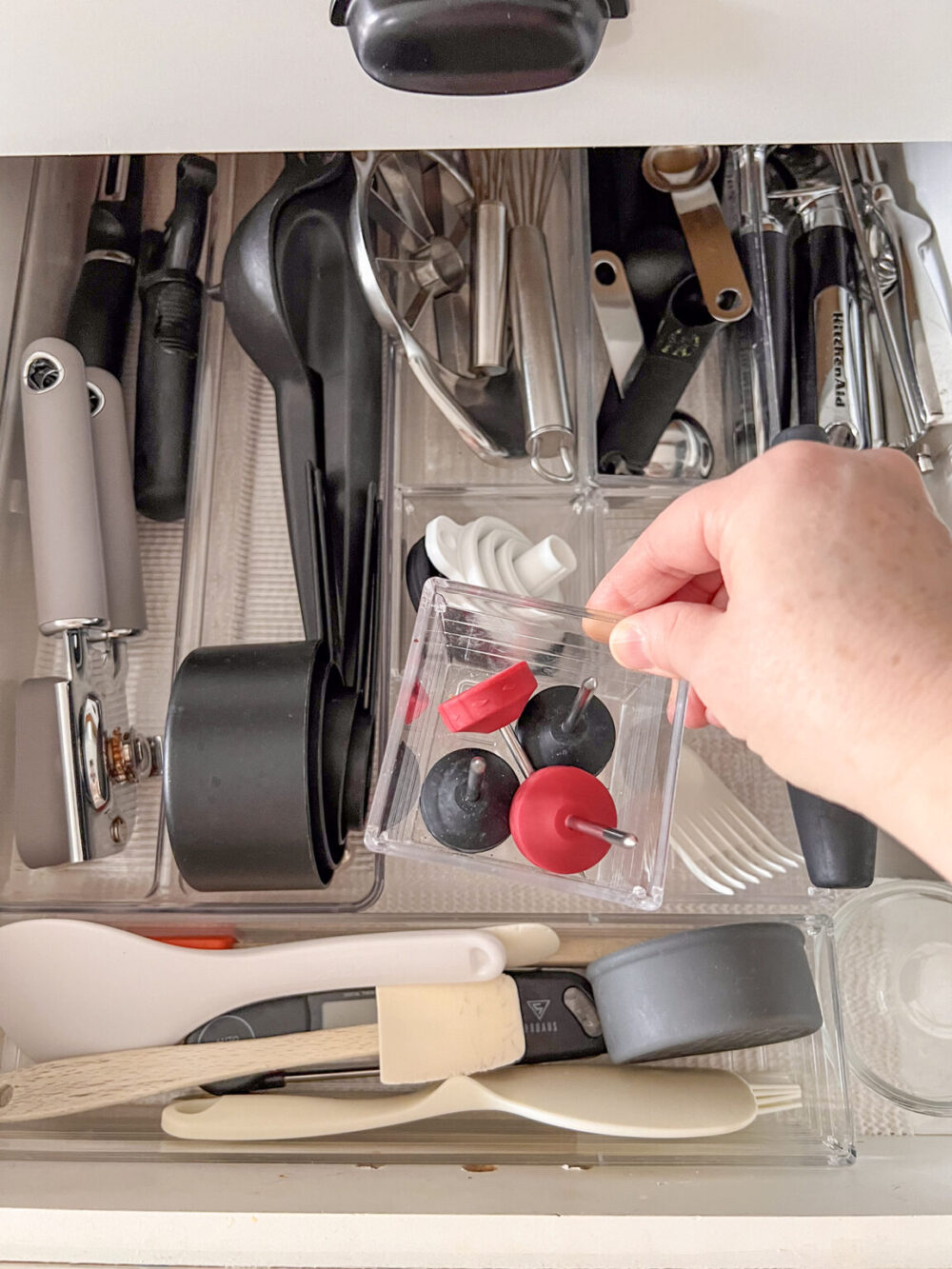
Try Backwards Decluttering on One Micro-Zone
You could try the same basic reversal with:
- one drawer
- one shelf
- one mantel
- one counter
- one cabinet
- one small section of a closet
- one category
Take the items out temporarily.
Then experience the space without them.
When you’re ready to put things back, don’t automatically return everything simply because it was there before.
Pay attention to what you actually want to return.
Let’s say you’re dealing with travel mugs.
Instead of picking up all 17 and trying to find reasons to get rid of them, temporarily clear the area.
Then choose the mugs you genuinely want to put back.
Your favourites.
The sizes you actually use.
The ones with lids that still exist. 😂
Then look at what’s left.
Maybe you want a few more.
Fine.
This isn’t a contest to see how little you can own.
You’re simply making the decision from a different direction.
This Isn’t About Tricking Yourself Into Getting Rid of Things
I think this is important.
The goal shouldn’t be:
How can I manipulate myself into throwing away more stuff?
You aren’t trying to win at decluttering.
You’re trying to create a home that works for you.
Maybe you intentionally bring back:
Your favourite books.
Your grandmother’s vase.
Family photos.
A collection you love.
Something completely impractical that simply makes you happy.
Wonderful.
You don’t have to justify those things to anybody else.
The point is simply that you’re seeing them again.
You’re choosing them instead of allowing everything to remain by default.
House Hushing and Backwards Decluttering: What’s the Difference?
These terms are closely connected.
In Myquillyn Smith’s original explanation, House Hushing is backwards decluttering.
The basic House Hushing technique is to temporarily remove the smaller items from a room, experience the quieter space, and then decide what comes back.
As Myquillyn’s House Hushing work has grown, she’s developed it into a broader approach to creating a simple, soulful home, with Backwards Decluttering now identified as one of its core principles.
So if you’re interested in the whole experience of quieting the visual noise in a room, read my guide to House Hushing.
Here, I’m especially interested in the decluttering decision itself:
What changes when we experience less before deciding what stays?
Backwards Decluttering and the Home RESET Method Solve Overwhelm Differently
This is where the comparison gets interesting.
Backwards Decluttering delays the decisions.
You temporarily remove the things, experience the space and make your decisions afterward.
With my Home RESET Method, I usually approach decision overwhelm by making the decisions smaller.
During Edit, we work micro-zone by micro-zone.
One drawer.
One shelf.
One surface.
One small area at a time.
Instead of asking you to make 300 decluttering decisions in one room, maybe we’re asking you to make twelve.
Then RESET keeps going.
You:
Remove the obvious.
Edit what you’re keeping.
Set temporary homes.
Experience those choices in real life.
And Tweak what’s not working.
Neither approach requires a giant weekend overhaul.
They’re simply two different ways of reducing the overwhelm.
Could You Use Backwards Decluttering During RESET?
Sure.
Backwards Decluttering is Myquillyn’s technique, not part of RESET.
But a useful tool can still be useful.
If you’re working through the Edit step and you’re completely stuck on one particular area, you might experiment with temporarily removing the things and experiencing the space differently before deciding.
Or you might simply borrow the mental shift:
Instead of only asking:
What can I get rid of?
also ask:
What do I genuinely want to keep here?
Sometimes changing the question changes the answer.
Then keep moving through the larger process.
Because deciding what stays is only one piece of creating a home that’s easier to manage.
Deciding What Stays Doesn’t Tell You Where It Should Live
This is where a lot of decluttering advice ends.
You made the decisions.
Great.
Now what?
Where should the things you’re keeping actually live?
Is that location close to where they’re used?
Will people realistically put them back?
What happens when real life starts happening in the room again?
Those are organization and systems questions, not decluttering questions.
That’s why RESET moves from Edit into Set, Experience and Tweak.
A useful decluttering technique can help you make a decision.
But your home still needs to function afterward.
So, Does Backwards Decluttering Work?
I think it can be especially helpful if decision fatigue is what’s keeping you stuck.
Instead of forcing yourself to make dozens of decisions before you get any visible payoff, you get to experience the quieter space first.
Then decide.
And if doing that with an entire room sounds overwhelming?
Don’t.
Choose one tiny area.
One drawer.
One shelf.
One surface.
Make the problem small enough to solve.
Then notice what changes when you stop asking only:
What should I get rid of?
and start paying attention to:
What do I actually want to bring back?
Sometimes seeing your space differently makes it easier to see your stuff differently too.
Backwards Decluttering is one of several decluttering methods that can make a particular part of the process easier. I’ve compared the most popular approaches and where each one fits here.
Not Sure Decluttering Is Actually the Problem?
If you’ve decluttered before but your home still feels difficult to manage, you may not need another decluttering technique.
Take my free Messy Home Diagnostic to find out whether clutter, organization or home habits are creating the biggest problem in your home right now.
Once you know what you’re actually trying to solve, you can use the right tool instead of starting over with another random method.

Want to see more content like this in your Google searches?
This button tells Google that Home Made Lovely is a source you like, so it can show you more of it.